

This everlasting battle, "online learning vs traditional learning", has been gaining traction in recent years.
Traditional Learning vs Online Learning
Traditional college, with its packed auditoriums and chaotic organization, might be facing disruption. Distance learning is becoming more and more popular each year.
Many students are deciding to forego traditional higher education and commit to an online university or a specialized course.
However, some of the arguments for distance learning are still unclear. At one point, it was merely a question of the quality of provided education. Nowadays, dualism in the educational sector is bigger than ever.
The momentum has shifted as high-quality webinars are changing people’s lives and becoming valuable additions to their resumes. However, before we completely turn away from traditional education, it is worth asking how it truly compares with online learning from an objective point of view. Let’s take a closer look at this discussion together.
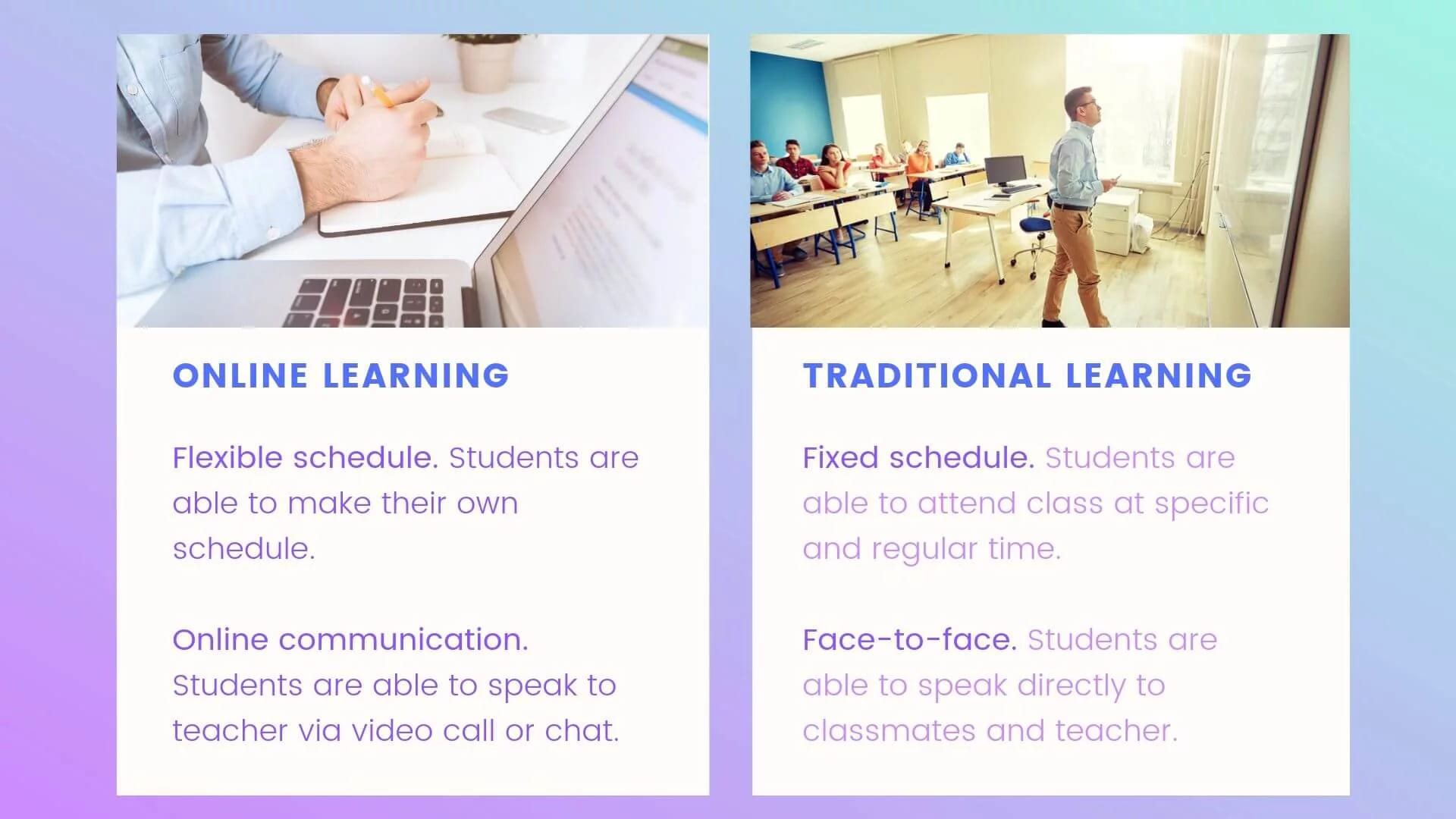
Flexibility
Online learning
Terrence Young, who works for an assignment writing service, believes online learning offers greater benefits than currently recognized. "With the current economic situation, more and more students see online learning as a great way to improve one’s academic and financial situation."
For example, you might be a college student who wants to deepen your knowledge of data science. Online learning, such as a course in data science, allows you to gain additional knowledge whenever you have free time. As a result, you have a degree and certification that makes you a more promising candidate.
Therefore, online learning offers a flexible timetable addition.
Traditional learning
This method is the best solution if a student or seminar attendee has a flexible work schedule. Some colleges offer a full program of non-mandatory classes, which is suitable for people who thrive on self-organization.
That freedom means somebody can turn up to your seminar in person rather than watch a webinar. But in terms of developmental psychology, where does discipline stand in all this?
Read also: Ethical Issues in Online Learning
Discipline
Online learning
For people who have unusual schedules, online education is the ideal choice. Most courses and webinars ask very little of an attendee beyond turning up.
With only a little reading and comprehension required of you, discipline slackens. Without motivation, you might easily drift off and let the studies or the webinar slide.
Traditional learning
Traditional education relied on the idea that physically forcing unmotivated students to attend classes would motivate them. The thinking was, mandatory attendance in a university or seminar would eventually make you learn.
Even if someone didn’t plan to join, they still had to listen to the lecture or talk. Meeting and interacting with colleagues and professors can be helpful, but is it really necessary?
The social factor
Online learning
Although there are stereotypes, online learning does, in fact, involve student-professor interactions. The way to accomplish this is simply different.
You can contact your lecturers or professors via video calls or in an online chat discussion. Or even the forums, which are seeing a rise in popularity.
Traditional learning
For those unmotivated and extroverted, traditional learning is still the best way. You develop a competitive flair by interacting with your colleagues or attendees at a seminar.
The competitive atmosphere would fuel you even if you weren’t eager to attend class or a lecture that day. Motivated people affect others, and you will have an urge to learn and succeed despite initially not having it.
The proposal for a fused model
A mixed educational model has shown to be effective as well, for both universities, seminars and those who these institutions serve.
Every college and every organised seminar justifies its marketing with the same claim, which is that more people learning is good for society. Attracting numbers is always the goal, so all sorts of students end up queuing to learn.
Offering quality learning is achievable in both systems. And often the choice comes down not to the learner’s preference but to external circumstances.
This is why it helps to participate in a webinar you can follow live or watch afterwards, and why a brick-and-mortar university that also offers online courses is worth looking for. Preferences differ and they change, so the two will go on existing side by side.
Coexistence
The key to both these models is coexistence. One day, you may not feel motivated to attend a course, but a competitive atmosphere will be a reinvigorating factor.
Another day, regular classes can bring disturbances to your work schedule. Combining traditional learning and online learning under a cohesive principle is a state from which we all can benefit.
Summary of online vs traditional learning
Each approach carries its own advantages and its own problems. Online learning buys you flexibility, so you study on your own schedule and from wherever you happen to be. A traditional classroom gives you structure, enforced discipline and the company of other people, which for many students is the thing that keeps them going. Put the two together and you get an education that fits more lives than either does alone. Which one is right is decided by the person, not by the format.
FAQ
What is the main difference between online and traditional learning?
The main difference is that online learning takes place virtually with learners accessing content and engaging with instructors remotely, whereas traditional education involves attending classes in person with face-to-face interaction between students and instructors.
Which is better, online learning or traditional learning?
Both online and traditional learning have advantages and disadvantages, and the better option depends on individual preferences and circumstances. Online learning is more flexible and convenient, but formal education offers more opportunities for social interaction and hands-on learning.
Why might online learning offer greater flexibility than traditional learning?
Online learning offers greater flexibility because you can gain additional knowledge whenever you have free time instead of being bound to a physical classroom schedule, which makes it more suitable for people with work or other commitments.
What challenge does online learning pose in terms of self-discipline?
Online learning can reduce the amount of enforced attendance and structure so that without motivation you might easily drift off and disregard your studies or webinar work, making self-discipline more important.
How does the social factor differ between traditional and online learning?
In traditional learning the competitive atmosphere and the physical presence of colleagues and professors can fuel motivation, while online those interactions happen through video calls or forums, which is different in nature but still a real connection.
Is there a model that combines both online and traditional learning approaches?
Yes, a mixed or fused model combines elements of both online and traditional learning so that students can benefit from flexible access and also from social interaction and hands-on experiences, meaning both methods can coexist rather than one replacing the other.