
Almost everyone seems to want to sell an online course these days. Nothing wrong with that, but it is worth noticing how crowded the market has become.
Best ways to sell online courses
The online learning industry started to soar in mid-2020, and forecasts published at the time had it growing from around $144 billion to well over $300 billion within five years.
And here is something that should pique your interest. Udemy alone carries well over a hundred thousand courses from tens of thousands of tutors, every one of them trying to sell online courses on that single platform.
Pretty big competition, right?
So how do you sell an online course in a way that stands apart from the crowd, attracts an audience and actually earns?
We’ve got you covered on this! This article explains the most effective and reliable ways to sell your online courses, so you can get great results.
Think of this approach as a chain reaction where you complete each step in sequence. This method makes it much easier to promote your online course because instead of beginning from zero at every stage, you keep building on what you have already created.
And here’s the best part because it will not cost you anything at all. So let’s get started!
Sell online courses with YouTube
While working out on the strategy, YouTube seemed like the ideal platform to start with! Assuming you’ve already created your online course, here’s what you need to do.
Instead of uploading your entire course to YouTube, share only a few parts, maybe four or five lessons. Try to post them on a consistent schedule. When your videos are high-quality and truly helpful, viewers will get interested and start waiting for your next upload.
Here’s where things take a turn. Every time you post a video, make sure you add links that redirect to your online course. Also, create a comment that includes a link to your online course (and pin this as well).
Even if only a tenth of the people who watch those lessons sign up for the paid course, that is real revenue.
P.S. Add SRT subtitle files when you upload. They make the videos usable without sound and give YouTube text to index, which is free SEO.
Create compelling blog posts
It’s common nowadays coming across the phrase "Content is the King"! Well, we couldn’t agree more with this (and so should you).
A well-researched and written blog post (following all on-page SEO guidelines) can drive extensive organic traffic!
Remember the SRT file you used for your YouTube video? With that as reference, come up with a blog post. Make it interactive, witty and at some point (in most cases, the end of the read), include a link that redirects the audience to your online course.
Also, to make your blog more interactive, create infographics as downloadable content (don’t forget to include a link address to your online course). If your user doesn’t have the time to read your blog post, they can always download the infographic and take a look at it later.
P.S. Choosing the right platform for your online course matters as much as marketing it. Make sure you choose a platform that gives you complete ownership in terms of revenue, marketing and management.
Harness your email marketing list
Email marketing is by far the most affordable way to market your online course. It costs you almost nothing per message, so the return beats any paid channel you can buy.
Create a newsletter to send the blog copy you just came up with to your email subscribers. Make sure you include links to your online course as well! If you’ve managed to catch the attention of your reader, you don’t have to worry about the conversion rates and revenue!
Here’s an example where Neil Patel has sent an email about his new free course.
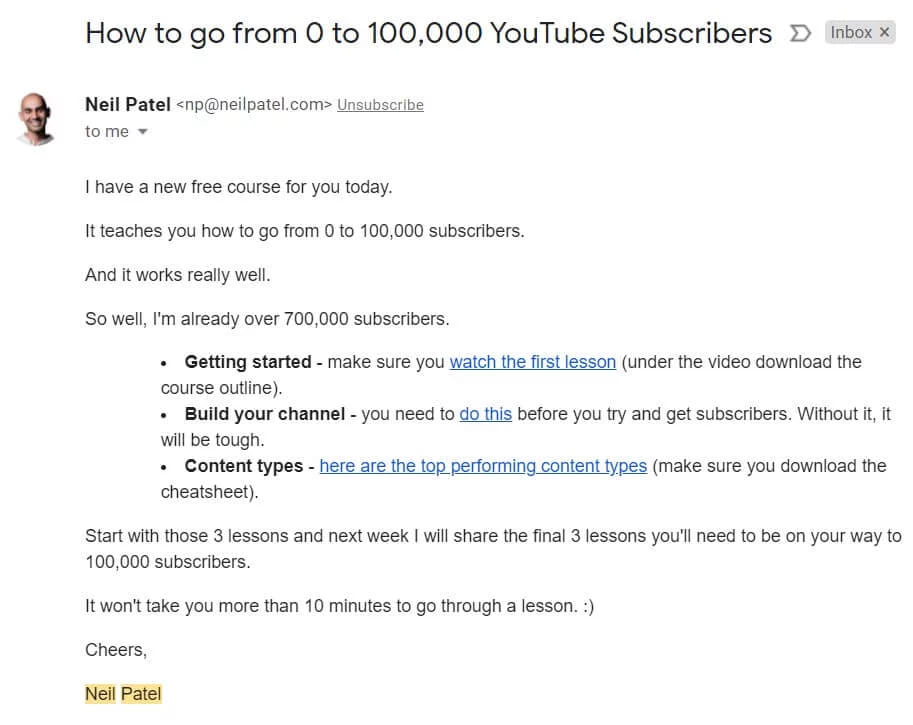
Since Neil has a huge marketing list, he directly encouraged his users to try his free course. He mentioned that he would share the final three lessons the following week, which suggests he has something planned. This detail is not really important here, but the main idea is what you should focus on and learn from.
P.S. If you don’t have a sizeable email marketing list, it’s highly recommended that you build one. Here, this read can help you know how to grow your email list.
Use social platforms as your marketing medium
You’re done with YouTube, blogs, and email marketing. Now it’s time to focus on your social media channels because one of your posts could suddenly create amazing buzz and bring great results.
Create excerpts from your blog post and redirect them to your blogs. You can also post short videos about your online course and redirect them to your course page!
Content strategist Julia McCoy does this well. Her social posts send readers to the company blog, and the article ends with a free guide to download, which is what grows the email list. In your case, send the audience to your blog and have them sign up for the course from there.
Make use of social post scheduling tools like Buffer to automate posts on popular platforms at set times.
Submit images on sites like Pinterest
The fast-moving lifestyle has left people with very little spare time. And browsing information on image search engines like Pinterest is becoming more popular.
Whenever you create images and excerpts for your blog, make it a practice that you submit on visual sites like Pinterest (with a link back to your blog). You can also submit the infographics that you created for your blog post.
What happens here is, you get increased visibility. When someone does an image search relevant to your online course, you eventually get visitors to your blog post which in turn takes them to your online course. Sounds pretty easy stuff, right?
Those are the main channels worth working through. There is one more, though.
Webinars to create and sell online courses
Just when we thought we had covered all the most promising options, we suddenly realized that we had overlooked one true gem in the crown, which is webinars!
Webinars are an excellent way to sell your online courses as well! What makes webinars super cool is that you get directly in touch with your audience and let them know what your course is about. You can even go ahead and give a taste of your online course to your audience and make them want more. Since it’s you who is conducting webinars, the trust factor increases, making webinars an ideal way to sell online courses. MyOwnConference lets you create and host them without much setup, so you can be running one this week rather than next month.
We have explained the most effective marketing channels that require no spending, and all you need to do is use some creativity while following the best practices on every platform.
So, which marketing method should you follow?
It’s not the question of which. It’s the question of how efficiently you use it! All the above-mentioned marketing techniques follow a sequence and are most effective when you follow it as mentioned.
You don’t need to invent something new every time you move to another platform. What you create at the start can later be expanded into various marketing materials, which is great for you and your online course too!
And here’s a little bonus!
While you create and sell online courses, it’s highly important that you choose the right platform to go ahead with! Enrolling yourself as a tutor in platforms like Udemy (that works on a commission model) restricts you from growing above a certain point.
Creating your own eLearning platform gives you complete ownership and also helps you grow in many different ways. You become a self-paced tutor, a marketer, and so much more.
Feeling inspired? Begin today and create your own course to share your knowledge and grow your business.
Cheers!
FAQ
How can I start selling my course using YouTube?
You can publish a few lessons (four or five) for free on YouTube, post them regularly, include links to your paid course in video descriptions and pinned comments, and gradually convert viewers to paying students.
Why should I write blog posts for my course?
Because a well-written blog post helps drive organic traffic via SEO, and you can embed links from the blog to your course and offer downloadable infographics to engage readers.
Is email marketing really effective for selling courses?
Yes, email marketing can bring a very high return on investment. Marketers who send genuinely useful content and link to their courses from it report returns no paid channel comes close to. This approach helps turn interested leads into paying customers.
Which social media strategies work best for course promotion?
You should create short posts or video snippets that link to your blog or course page, reuse content across platforms, and use scheduling tools to post consistently.
Why host webinars to sell courses?
Webinars let you interact directly with your audience, showcase course content live, build trust, answer questions in real time, and lead participants to enroll after seeing the value.