
When the coronavirus outbreak spread across the world in 2020, governments and private companies responded with quarantines and a rapid move to remote work. The playbook they wrote then still applies whenever an office has to empty out at short notice.
Working and learning from home
With citizens asked to stay at home and go out only when necessary, work and study had to carry on regardless. Here is how to move both online using video conferencing.
How to move employees to remote work
In case the type of work allows working from home, it is high time to do so. But how can one stay in touch with one’s colleagues and avoid losing effectiveness?
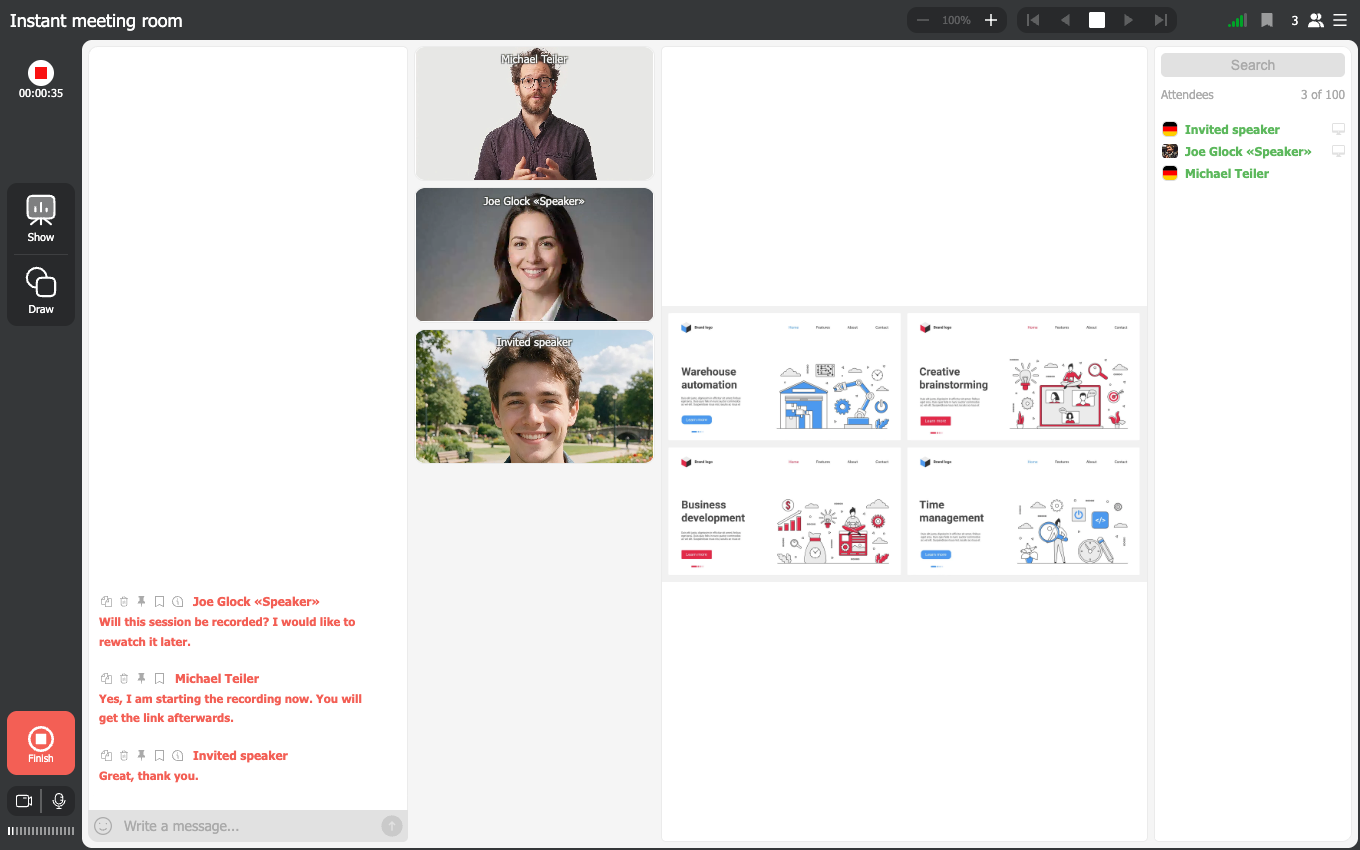
In addition to the already traditional phone calls and communication via messengers, hold online meetings and video conferences. MyOwnConference can offer all the tools required for that:
- Keynote demonstration. An employee can deliver a keynote about a certain task and demonstrate it to the other colleagues.
- Screen sharing. One of the participants can initiate screen sharing using one’s own computer, while the rest can view websites or applications running there.
- Chats. Participants can exchange text messages.
- Polls. This is a quick way of voting for some particular matter and making the final decision.
- Meeting recording. If any of the participants miss the meeting or some of its parts, they will be able to view its recording later.
How to move events online?
Gathering a lot of people in the same room becomes dangerous. Fortunately, this is no reason for canceling the event, for which you have been preparing so long. Most events can be moved to the online format.
Webinar software provides everything that may be necessary for this. First of all, you can restrict access to an online event, so that only the people who paid to take part can get in. Secondly, speakers can make their presentations using webcams and microphones and demonstrate their keynotes at the same time. Moreover, different means of providing feedback are available, e.g., participants can use chat, answer questions and even go on air.
School quarantine
With the help of video conferences and webinars, teachers can meet their students in a virtual classroom. Here, all tools required for teaching and knowledge assessment are available:
- Whiteboard where teachers can make notes, write tasks and explain anything.
- Demonstration of materials, graphs, presentations and educational videos.
- Shared files (textbooks, brochures, documents with tasks) that each student can download to their own computer.
- Tests for knowledge assessment.
Colleges and universities under quarantine
Many colleges have been using distance learning in parallel to their full-time and extramural curriculum. So, the best and the safest variant is moving all students to distance learning. If for whatever reason, your college has not done this so far, it is high time to do it now.
We have already written about how universities can use webinars. In brief, they can use them for lectures in big groups, as well as practical classes in small groups, along with Doors Open Days traditionally held in March and April for many establishments.
Key takeaways on remote work and learning
Nobody could say at the time how long the disruption would last, and the same is true of whatever comes next. What helped then still helps now, which is to stop worrying about the part you cannot control and get the meaningful work moving.
The MyOwnConference team will help you take teaching, learning, working and events online with minimum loss:
- Use our free forever Starter plan for 5 attendees;
- Hold webinars and video conferences for the audiences of 5 to 5,000 people;
- Run webinars in parallel, and run them for as long in the day as you need.
Whatever pushes your team apart, the tools to keep it working together are already here. We wish you, your coworkers and your families good health and a steady spirit.
FAQ
What are the main tools for enabling remote work and learning when working from home?
In situations where work and learning must move online, it is useful to rely on video-conferencing platforms that allow keynote presentations, screen sharing, chat, polls, and meeting recording so that all participants can stay connected and engaged.
How can I move an in-person event into an online format with minimal disruption?
When large gatherings become risky, you can transition the event online by restricting access to paid participants, using webcam and microphone for speakers, enabling presentation sharing, and offering chat and question features so the audience can still interact meaningfully.
What options do teachers have to conduct remote classes during school quarantine?
Teachers can use virtual classrooms that include whiteboards for taking notes, shared files such as textbooks and assignments that students can download, options to show materials through presentations or videos, and tools for testing knowledge. All of this works smoothly when supported by reliable video conferencing or webinar software.
What is the safest choice for colleges and universities when full face-to-face learning becomes impossible?
Many universities have already operated distance-learning alongside traditional classes, but when the on-site option must end, the safest route is to switch fully to remote formats using webinars and virtual lectures so that teaching continues without major pause.
How should individuals respond to the pandemic’s impact on traditional work and education to minimize disruption?
Although the global health situation is uncertain, it is best not to panic but to focus on meaningful tasks, adopt digital tools for working, learning and events, and recognize that moving online is an opportunity rather than just a challenge.