
Alternative broadcasting technology (DTS app)
MyOwnConference gives you three ways to broadcast, and the account owner picks one of them for each room. The default is the browser on its own, through the WebRTC technology built into it. The second is the browser plus a small app called DTS that you download and run on your computer, and that one is the alternative broadcasting technology this article is about. It carries your audio and video over our own low-latency TCP protocol instead of WebRTC, and it runs on Windows and macOS. The third sends a finished stream from OBS Studio, which is a different tool for a different job and has its own guide.
Switch to it when the browser route itself is the problem, for instance when a company firewall blocks the UDP protocol WebRTC needs, or when the link is too weak to hold a browser stream steady. If you are heading into a company network and want to know what the room already does on its own, broadcasting from a corporate network sets that out first.
One case it does not solve is a browser that has been refused access to your camera and microphone. That is a permission held by the browser, and no change of broadcasting technology reaches it, so clear the refusal first with going on air.
Why it helps
- It holds a steadier connection than the browser route on a slow or lossy line.
- It works where the browser cannot, for example when WebRTC is switched off or when a company firewall blocks the UDP protocol.
- It works over a VPN, so you can both watch and broadcast through one. Steer clear of free VPN services, because their bandwidth is rarely enough for steady audio and video.
Sometimes there is simply no way to identify what is blocking WebRTC. At that point switching technology beats carrying on with the debugging. If you would rather try to fix WebRTC first, see How to enable WebRTC in your browser.
Who has to install it
Only the account owner can activate the alternative technology. Once it is on, it applies to everyone who speaks in that room, so every moderator and every speaker has to install the app.
Attendees are unaffected. They download nothing and join through the usual link exactly as always.
Switching the room over
The choice lives in your dashboard rather than inside the room, so make it before the event starts.
Open "Webinar rooms" or "Scheduled webinars", depending on where you created the event. Those are the pages behind "Rooms" and "Calendar" in the sidebar. Click the three dots next to the name, choose "Settings", and find "Streaming source" on the "General" tab.
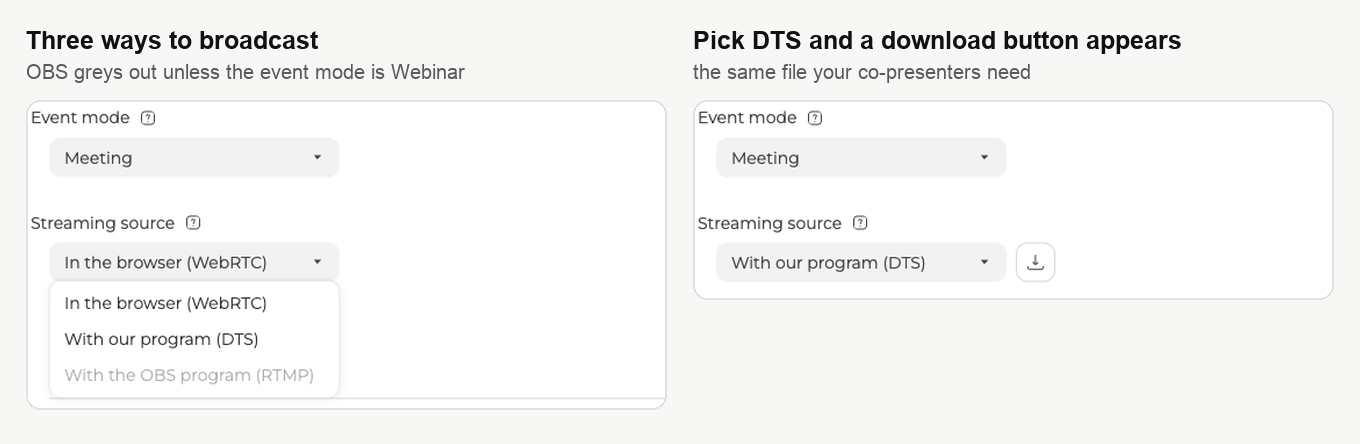
Three options sit in that list:
- "In the browser (WebRTC)" is the default, and the one every room starts on.
- "With our program (DTS)" is the alternative technology this article is about.
- "With the OBS program (RTMP)" is a separate route for broadcasting from OBS Studio, which broadcasting into the webinar room from OBS Studio covers. It stays greyed out while "Event mode" is set to "Meeting", so change the mode to "Webinar" first if you want it.
They are not three grades of the same thing. Each one trades something away, and the table sets out what.
| In the browser (WebRTC) | With our program (DTS) | With the OBS program (RTMP) | |
|---|---|---|---|
| Who can be on air | every speaker your plan allows | the same, once each has installed the app | one speaker, and only one |
| Between presenters | 100 to 600 ms on a healthy line | the same range | the stream travels one way, so there is no exchange |
| What your audience waits | a small buffer on top, which stretches only when a line is struggling | the same | about ten seconds, and as much as twenty |
| Where it runs | every system we support, Linux included | Windows and macOS only | wherever OBS itself runs |
| What it costs | nothing, it is the default | nothing, it is on every plan | Business or Enterprise, and not the one-day plan |
| What you set first | nothing at all | the owner switches the room over, then every speaker installs the app | the same switch, plus "Event mode" on "Webinar" |
The one thing OBS buys you that neither of the others does is a 1080p picture, which is why people accept its delay. Broadcasting into the webinar room from OBS Studio works through the whole setup.
Pick the DTS option. The setting saves itself, and a download button appears next to the list, which is the quickest way to get the file to your co-presenters. Tell them before the day, not during it.
The same list puts the room back on "In the browser (WebRTC)" whenever you want, and your speakers can then ignore the app.
Once the app carries the stream, the room's "Devices settings" grows two sound controls the browser route does not have, and loses one thing, since "Blur background" is not available on this route yet. Audio quality for webinars sets out what they do, and what the route costs you in echo and noise suppression. On a Mac the missing switch changes nothing, because macOS applies its own "Portrait" blur and its own "Background" replacement before the picture reaches any application, as virtual backgrounds on macOS explains.
Installing the app
If you skipped the download button in the dashboard, the room offers the app the first time you press "Speak" without it.
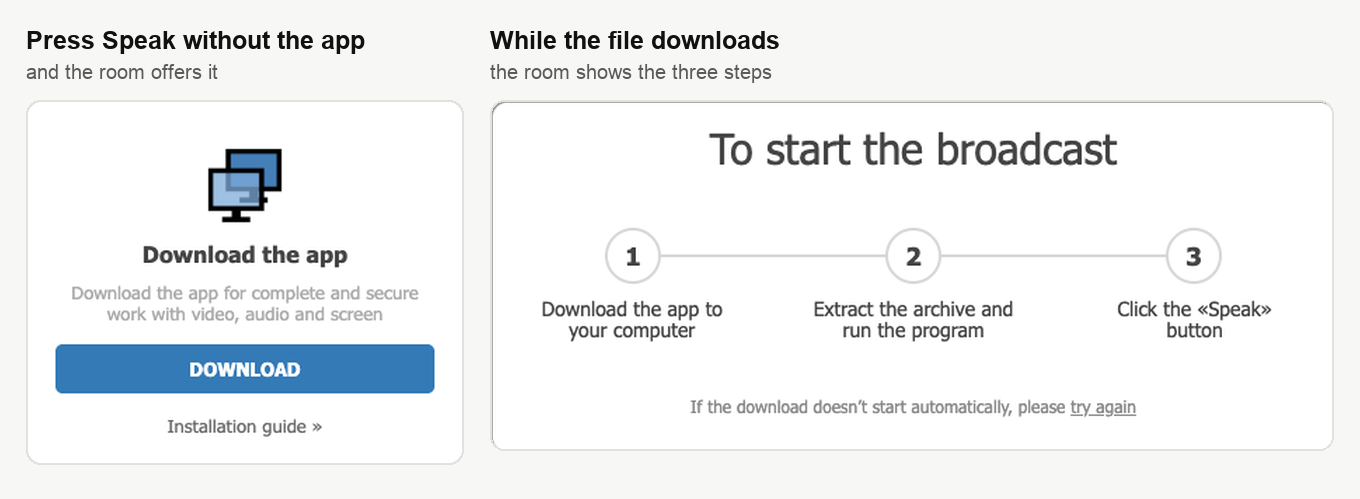
Take it. The alternative technology only works with the app running. Those three steps describe the Windows package, because macOS gets a disk image rather than an archive, and the two sections below give each system its own version.
The room menu also carries a "Download" entry at the bottom, so you can fetch the file at any point without pressing "Speak" first. Whichever route you take, the file matches the system you are on.
On Windows
Open your Downloads folder and unpack the ZIP, keeping DTS.exe and the DTS folder beside each other, then double-click DTS.exe. There is nothing to install, since the archive holds the app itself. The app is signed with a Microsoft certificate.
Once it is running, the DTS icon appears in the taskbar. Go back to the webinar room, refresh the page and press "Speak". If the room still does not see the app, restart the computer and try again.
If DTS.exe will not start at all, or it starts and your webcam stays black, check whether your Windows is an N edition. Those ship without the media components the app needs, and activating the Media Feature Pack puts them back.
On macOS
Open the disk image and drag DTS across into Applications, then launch it from there.
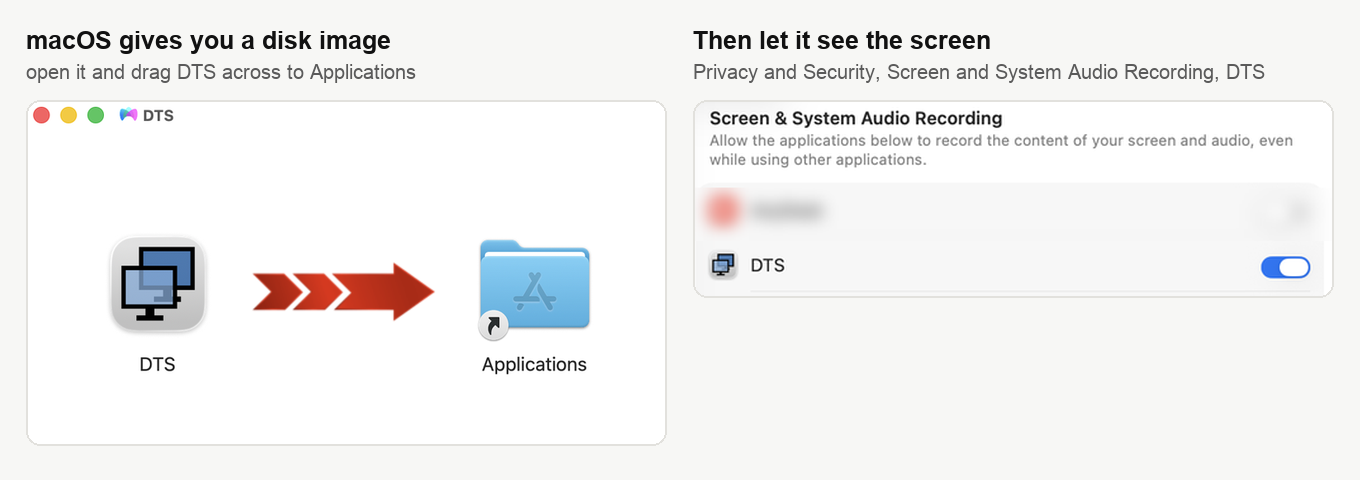
If macOS shows a security window saying you have just downloaded this app from the internet, click "Open". If it refuses to open the app at all, hold Control, click the DTS icon, choose "Open" from the menu and confirm. macOS remembers the choice, so from then on a double-click is enough.
Once it starts, macOS tells you in a notification that DTS has been added to your login items, which means DTS starts with your computer from then on and you never have to launch it by hand again.
Sharing your screen through the app needs one extra permission, which is DTS under "Screen & System Audio Recording". DTS asks for it itself the first time you run it, in a window headed "Screen Recording", and the "Open System Settings" button on that window takes you straight to the pane. Switch DTS on there. macOS wants Touch ID or your password first, since this counts as changing a system setting.
It then offers to restart the app. Take the offer, and start DTS again from Applications yourself afterwards, because the reopen it promises does not happen. Until that switch is on, the app runs and the room finds it, but the picker shows your bare wallpaper with none of your windows on it, which how to share your screen during a webinar covers in full.
Return to the webinar room, refresh the page and press "Speak".
Before you go live
Check the app is running. As you enter the room it offers a check of your equipment and internet connection, which is worth taking the first few times, and you can run it again from "Help center" in the room menu. Well ahead of the event you can also check the line with our connection tester.
If the room keeps asking you to download an app you already have
The app itself is almost never the problem. Either an older copy is still sitting in memory, or the browser has been told not to work with apps on your computer, or your machine resolves the app's address to the wrong place. The steps below run from the quickest to the most involved, and most cases end at the first one.
Start with a clean restart, on Windows
Look at the taskbar corner first. Our icon shows two monitors, and it usually sits under the arrow that reveals the hidden icons rather than out on the taskbar itself. If you find it, an older copy of the app is already running, and that copy is what the room keeps failing to reach. Right-click the icon and choose "Exit", the last of the four entries in that menu, to unload it.
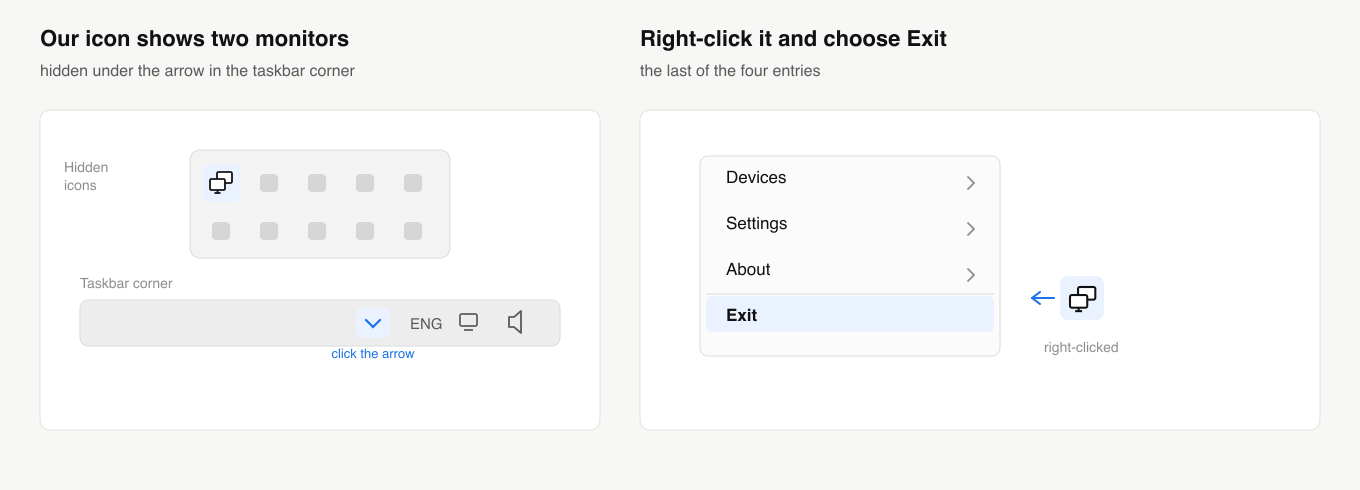
Now download the current version, either from the webinar room or from your dashboard, and unpack the archive together with its DTS folder, keeping the two side by side. Anywhere convenient will do, the desktop included. Run the copy you have just unpacked, then restart the computer.
Restart it even if you found no icon in the tray. Windows sometimes keeps holding the previous copy until it is restarted, and on its own that restart clears the repeat prompt more often than anything else on this page.
Once the computer is back, check that the two-monitor icon is in the tray, then open the room and press "Speak". Carry on down this page only if the prompt is still there.
Let the browser work with the app
Chrome asks each site separately whether it may work with an app installed on your computer, and calls that permission "Apps on device". The room needs it, because the app runs on your machine rather than inside the page. Blocked, the permission leaves the room unable to reach an app that is running perfectly well, and the room does the only thing left to it, which is to offer the download again.
Edge, Opera and Brave name it exactly the same way, so everything below applies to them unchanged. Vivaldi is the one exception, calling the same permission "Services on This Device" on its Privacy and Security settings page, in the Website Permissions list.
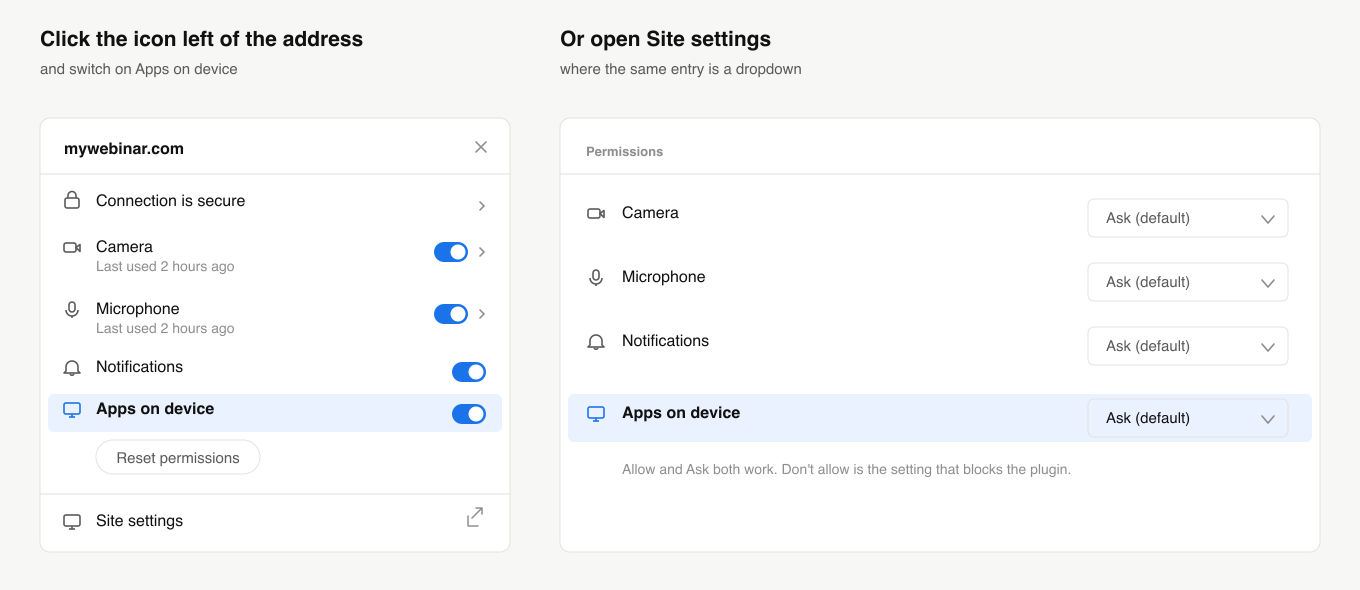
Click the icon to the left of the address in the address bar. The panel that opens lists what this site is allowed to do, camera and microphone among them, and "Apps on device" sits in that list. Switch it on. "Site settings" near the bottom of the same panel opens the fuller page, where the same entry appears as a dropdown, and there both "Ask (default)" and "Allow" are fine. "Don't allow" is the setting that breaks it.
Then reload the webinar room and press "Speak".
Switch to Google DNS
The room reaches the app on your own machine through the address add-on.mywebinar.io, which is supposed to resolve to 127.0.0.1, and some internet providers answer that lookup with an address of their own instead. The app is running, the browser cannot find it, and nothing you do inside the room helps.
Changing the name servers your computer asks is the simplest way past that, and it touches no system files. How to set up Google DNS on Windows 11 has the steps.
Check your antivirus
Some antivirus products quarantine the app. If yours has, add the app to its exclusions, following your vendor's own instructions.
Point the name at your own machine by hand
If nothing above changed anything, you can skip the lookup altogether and point the name at your own machine.
This is the most involved step on the page. If it looks like more than you want to take on, go back to the Google DNS step above, which is the easy version of the same fix and settles most of these cases on its own.
On macOS open Terminal, which you can find by typing "Terminal" into Spotlight, and run the following, entering your computer password when asked.
sudo nano /etc/hostsOn Windows, find Notepad and run it as Administrator, then open the file named hosts, which lives in the folder C:\Windows\System32\drivers\etc. You may have to set the file-type filter in the open dialog to All Files before it appears.
Either way, add these two lines at the very bottom of the file, each on its own line.
127.0.0.1 add-on.mywebinar.io
::1 add-on.mywebinar.io
On macOS press Control-O to save and Control-X to exit. On Windows, if it refuses to save into that folder, save the file elsewhere and copy it back over the original. Then refresh the webinar room and press "Speak".
We deliberately do not make this edit for you, because a change of that weight to your system settings should stay under your control.
Opera with the built-in VPN
If you broadcast from Opera with its VPN switched on, the browser needs permission to reach the app on your own machine. The rule to add is *.mywebinar.io, which covers the app's address and the fallback it uses when that one is unreachable.
Broadcasting from Opera with the built-in VPN shows where that setting lives, and covers what the VPN does to a browser broadcast and what a free one costs you. Once the rule is saved, reload the webinar room and press "Speak". If the room puts you on air, the rule is working.
Still not broadcasting
A few things are worth checking before you write to us. Confirm the app is genuinely running, since it is easy to close by accident, and that you refreshed the webinar room after starting it. Then confirm the address above resolves to your own machine, which the section on repeat prompts covers.
If none of that gets you on air, open the online chat and tell us which system you are on, which browser you present from, and what the room does when you press "Speak". We will work through it with you.
If you came here for screen sharing rather than for camera and microphone, how to share your screen during a webinar picks up where this leaves off, from installing the app to choosing a monitor or a single window.
Uninstalling the DTS app
On Windows
The app needs no uninstalling. It never installs itself on Windows, keeps no working folders and saves nothing on your computer, so removing it takes two steps.
- Close the app. Find our icon with two grey monitors in the taskbar corner, usually under the arrow that reveals the hidden icons, then right-click it and choose "Exit". Windows cannot delete the files of an app that is still running, which is why this step comes first.
- Delete
DTS.exetogether with theDTSfolder beside it, wherever you unpacked them, and the ZIP archive as well if it is still in your Downloads folder.
That removes the app completely and for good, because nothing else of it stays on your computer. Should you need it again, the webinar room and your dashboard offer a fresh copy. A room that is still switched to the app offers the download again the next time you press "Speak", and the account owner can put it back on "In the browser (WebRTC)", as the questions below explain.
Frequently asked questions
Does the app cost anything?
No, DTS is on every plan and costs nothing, the same as the default browser route. The route that does depend on your plan is OBS, which needs Business or Enterprise and is not available on the one-day plan. What DTS asks of you instead is lead time, since every moderator and every speaker in that room has to install it, so tell them before the day rather than during it.
Can we put the room back on the browser afterwards?
Yes, at any time, because the same "Streaming source" list puts the room back on "In the browser (WebRTC)" and your speakers can then ignore the app. Only the account owner can move it either way. The choice lives in the dashboard rather than inside the room, so make it before the event starts.
Does the app add delay compared with the browser?
No, the two routes sit in the same range, which is 100 to 600 ms between presenters on a healthy line, with a small buffer on top for your audience that stretches only when a line is struggling. What the app buys you is steadiness rather than speed, since it holds a connection better on a slow or lossy line. The route with real delay is OBS, at about ten seconds and as much as twenty.
On macOS the screen picker shows my wallpaper and none of my windows. What is missing?
The "Screen & System Audio Recording" permission, which DTS asks for itself the first time you run it, in a window headed "Screen Recording". Switch DTS on in that pane, confirming with Touch ID or your password, then start DTS again from Applications by hand, because the reopen it promises does not happen. Nothing reports an error until you do, and how to share your screen during a webinar covers it in full.
One of our presenters is on Linux. Can they use the app?
No, the app runs on Windows and macOS only, so a presenter on Linux cannot go on air in a room that has been switched to DTS. The browser route runs on every system we support, Linux included, so leave the room on "In the browser (WebRTC)" if that person has to speak. How to enable WebRTC in your browser covers the blocks that push people to the app in the first place.
